
Most security teams spend more time triaging than securing.
It’s a quiet paradox inside modern application security programs. Organizations invest in multiple scanning tools to strengthen their defenses, yet the very systems designed to improve security often overwhelm teams with findings. Instead of focusing on eliminating real risk, analysts and developers find themselves consumed by reviewing alerts, validating results, and separating signal from noise.
The challenge isn’t a lack of visibility. It’s too much of it without enough intelligence to interpret what actually matters.
When Noise Becomes the Real Threat
False positives may appear harmless on the surface, but their operational impact is substantial. Every flagged alert must be opened, and every vulnerability must be validated, requiring teams to manually review, validate, and decide whether it truly poses a risk.
Over time, this process accumulates into a significant drain on resources, with manual triage cycles sometimes taking hours to complete. Multiply that by the number of applications, releases, and tools in use, and suddenly a large portion of your security investment is spent confirming what isn’t a problem.
The cost shows up in ways that are harder to measure:
- Developers pulled away from feature delivery.
- Security analysts are stuck validating repetitive findings.
- Alert fatigue and burnout.
- Critical vulnerabilities buried under low-value noise.
When attention is divided across hundreds of findings, the likelihood of overlooking a genuinely exploitable vulnerability increases. In that sense, false positives don’t just slow teams down; they distort priorities.
A Scenario Most Teams Recognize
In a typical release cycle, multiple scanning tools analyze an application and generate extensive reports. As teams begin reviewing them, they frequently discover overlapping findings across tools, alerts triggered by generic detection patterns that don’t apply to their environment, and issues that require deep contextual understanding to assess accurately. Sorting through these results can take hours, delaying releases and diverting attention from development work.
This isn’t a failure of scanning technology. It’s a limitation of how results are interpreted.
Why Traditional Tools Generate Noise
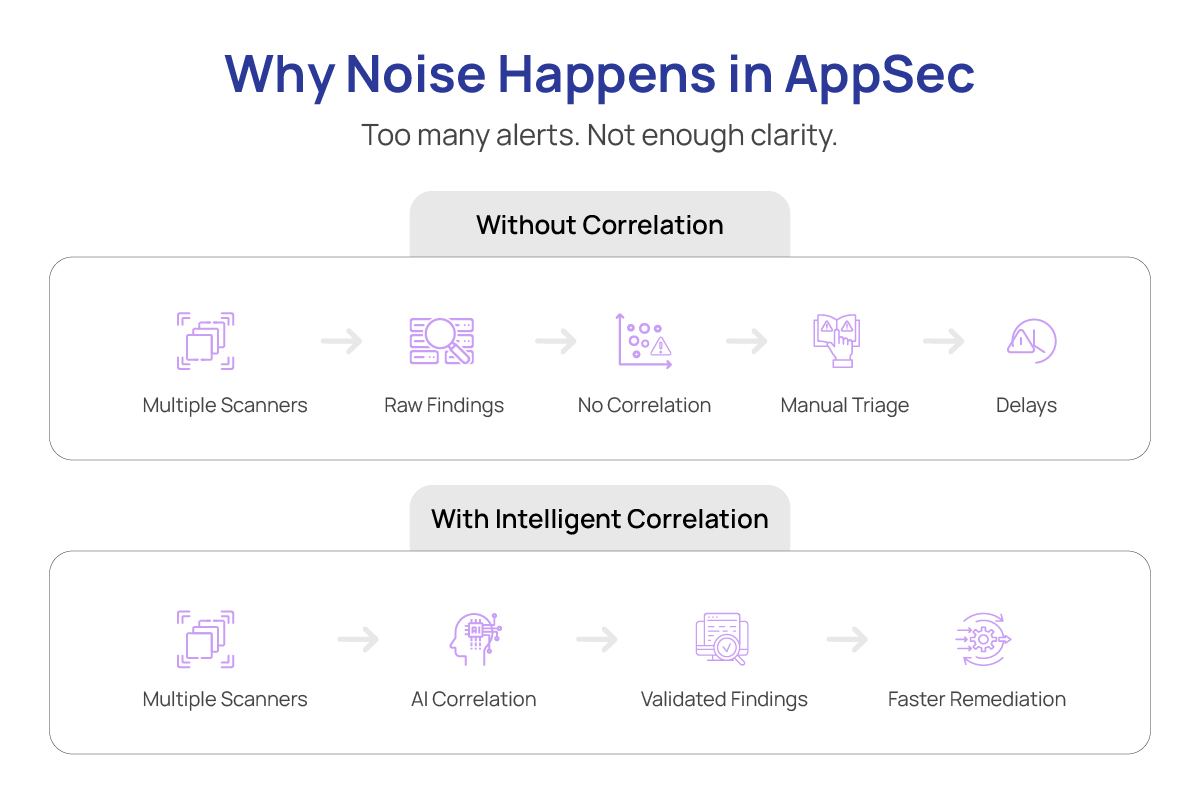
Most traditional tools are designed to detect potential vulnerabilities, not determine their real-world exploitability. They operate independently, analyze patterns in isolation, and lack visibility into organizational context. As a result, teams receive raw outputs rather than prioritized intelligence, leaving them to correlate findings manually.
As organizations scale their security stack, this fragmentation can increase noise rather than clarity. More tools generate more findings, but not necessarily better insight. Without correlation, prioritization, or contextual awareness, teams are left with raw data rather than actionable intelligence. Without correlation, prioritization, or contextual understanding, teams are left working through raw findings instead of focusing on real risk.
This is what that looks like in practice:
What Intelligent Correlation Changes
What’s increasingly needed in application security is not another scanner, but a layer that can interpret scanner output intelligently. Filtra AI from NuSummit Cybersecurity addresses this challenge by acting as a smart analysis layer between existing security scanners and the teams who rely on their outputs. Rather than replacing SAST, DAST, or other tools, it enhances their value by ingesting scan reports and analyzing them using artificial intelligence, machine learning, rule correlation, and contextual understanding of code, evidence, and vulnerability patterns.
When findings are correlated and validated automatically, the operational impact becomes immediately visible. Organizations can reduce alert volume by as much as 70 percent, cut manual triage effort by around 60 percent, and improve true-positive identification accuracy by up to 85 percent. In some workflows, review time that once took hours can shrink to roughly one hour per cycle, allowing teams to shift their focus from investigation to remediation. The shift isn’t just quantitative. It’s strategic. Security teams regain clarity, developers regain momentum, and releases move forward without unnecessary delays. Instead of reacting to alerts, organizations can act on verified risk.
Security Maturity Is Measured by Signal Quality
There’s a common assumption that stronger security comes from running more scans or adding more tools. In reality, maturity isn’t determined by how many alerts you generate, but by how effectively you can identify the ones that truly matter. That’s why the next evolution of application security isn’t about detection alone. It’s about intelligent interpretation. Filtra AI transforms raw scan data into prioritized, contextualized intelligence, and security shifts from being a bottleneck in development to becoming an enabler of speed, confidence, and consistency. Because ultimately, real security doesn’t come from seeing more vulnerabilities, but by identifying the right ones.